If you have started trading for a prop firm, you have probably been told to "keep a journal." But a prop trading journal is not the same thing as the trade log a retail trader keeps. This post explains what a prop trading journal actually is, how it differs from a regular journal, and why you need one once you are trading funded capital.
What is a prop trading journal?
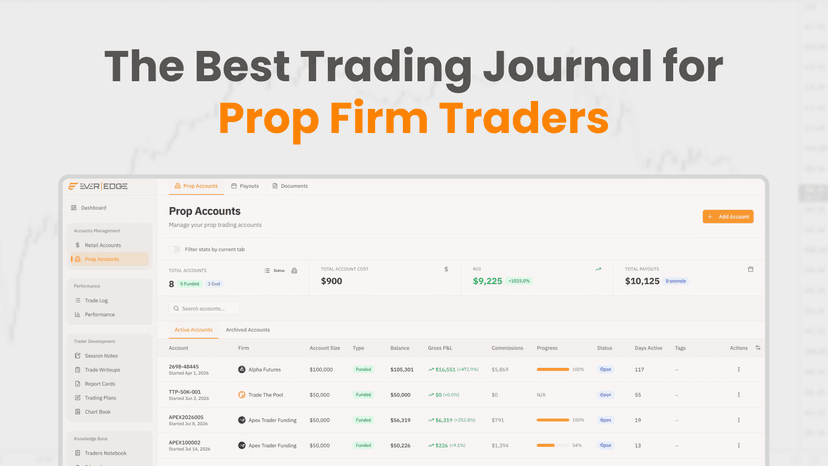
A prop trading journal is a record of both your trades and the funded accounts you trade them in. A regular trading journal tracks your entries, exits, and results. A prop trading journal does that too, but it adds a second layer that only matters when you trade for a prop firm: the accounts themselves, their rules, their costs, and the payouts they produce.
That second layer is the whole difference. When you trade a personal brokerage account, the account is just where your money lives. When you trade a prop account, the account is something you paid for, with a profit target to hit, a drawdown you cannot breach, and a payout split you collect when you pass. The account has a life of its own, and a prop trading journal is built to track that life alongside your trades.
Short version: a regular journal answers "how are my trades doing?" A prop trading journal also answers "how are my accounts doing, and am I making money after everything the firm charges me?"
Prop trading journal vs a regular trading journal
Here is the practical difference, side by side.
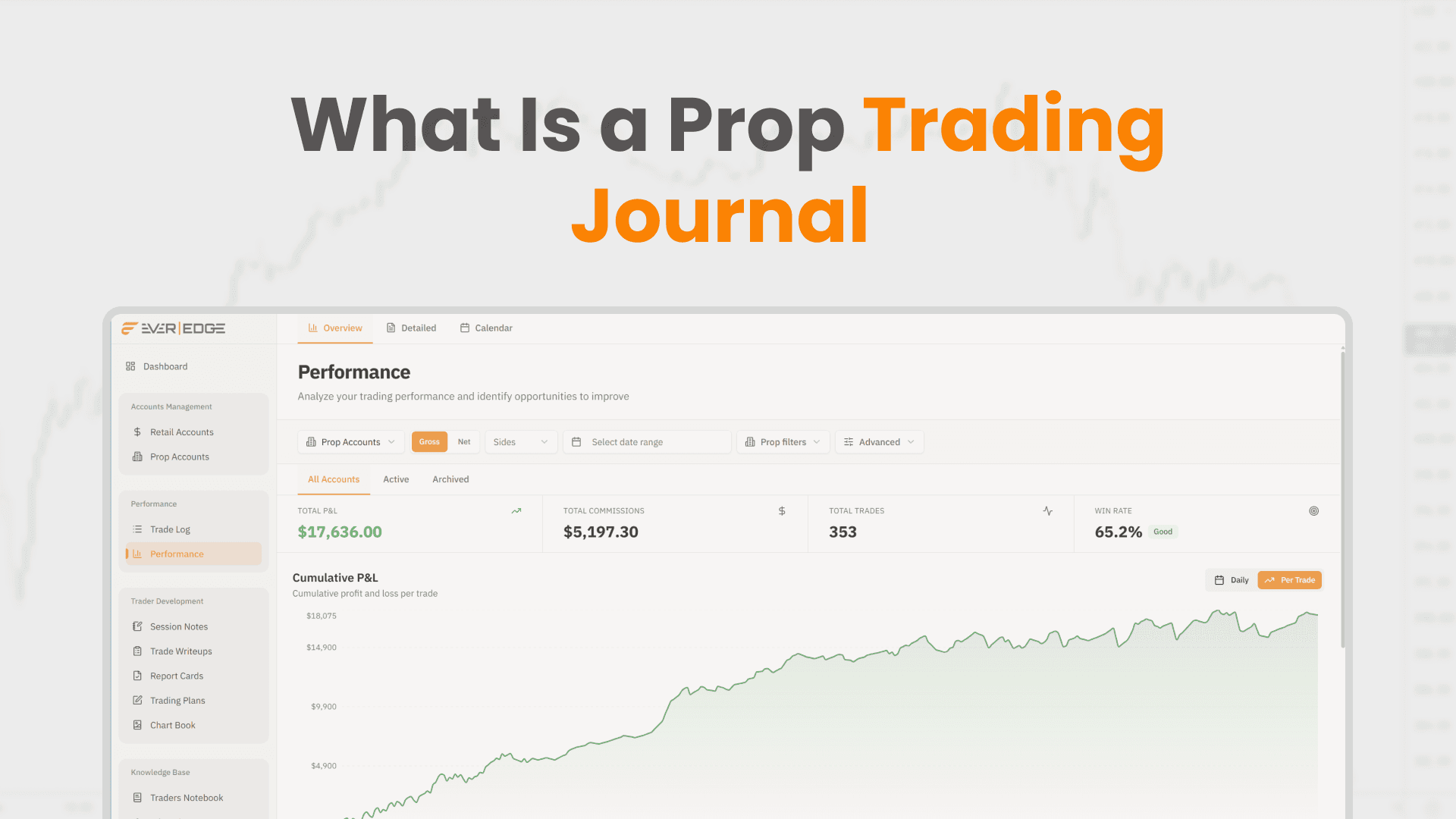
A regular trading journal tracks your trades: the ticker, entry, exit, size, P&L, and your notes on the setup. That is enough when you trade your own capital.
A prop trading journal tracks all of that, and also:
- The accounts. Which firm, evaluation or funded, the size, the balance, and the P&L on each account you run.
- The rules. Profit target, max daily loss, and max total drawdown, the limits that can end an account.
- The status. Whether each account is open, passed, failed, scaled, or blown, so you know your real pass rate.
- The costs. Evaluation fees, activation fees, and resets, so you know what your funded income actually cost you to earn.
- The payouts. Each payout, its split, and your net across every account.
- The paperwork. Receipts and certificates, kept with the account, ready for tax season.
If you only track the first list while trading prop accounts, you are flying half blind. Your trades can look green while the accounts quietly lose money after fees, and you would never see it in a plain trade log.
Why you need one when you trade funded capital
You might be thinking your normal journal is fine. Here is why it stops being fine the moment you go funded.
You are running more than one account
Almost no prop trader runs a single account. You might have an evaluation with one firm, a funded account with another, and a reset you just bought. Each has different rules and a different balance. A regular journal shows you one blended P&L. A prop trading journal shows you each account on its own and all of them together, which is the only way to see which accounts are actually working.
Your costs come before your income
Every evaluation and reset is money out of your pocket before a payout ever lands. If you are not tracking account costs, you do not know your real return. Plenty of traders feel like they are winning because their trades are green, while their eval fees quietly eat the profit. A prop trading journal makes that math honest.
The rules can end you in one day
Max daily loss and trailing drawdown do not care how good your week was. Journaling against the actual limits of each account, not a rough guess in your head, is how you avoid the dumb account-ending mistake that has nothing to do with your edge.
Payouts and taxes are real now
Once you are collecting payouts, that is income, and the fees you paid are business expenses. Keeping payouts, splits, and receipts organized as you go turns tax season into a non-event instead of a scramble through old emails.
The moment you are paying for accounts and collecting payouts, you are running a small business, not just placing trades. A prop trading journal is the bookkeeping and the performance tracking for that business in one place.
What a good prop trading journal looks like in practice
You do not have to build this in a spreadsheet. A tool like Everedge combines the trade journal and the account layer in one place, so your trades and your prop accounts live together instead of in two disconnected systems.
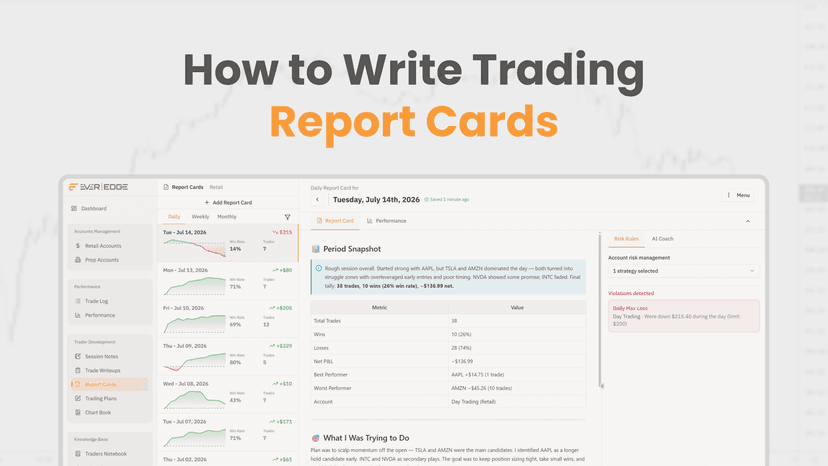
The trade side works like any strong journal: every trade logged with its details, and a single-trade view for reviewing a specific fill.
The account side is what makes it a prop journal: your accounts, their rules and status, your costs, and your payouts, all tied back to the same trades.
We go deep on exactly what to look for in that account layer in a separate post. If you are at the stage of choosing a journal, read The Best Trading Journal for Prop Firm Traders next, which walks through every feature a funded trader actually needs.
Common questions
- Is a prop trading journal different from a trade log? Yes. A trade log records trades. A prop trading journal records trades and the funded accounts, rules, costs, and payouts around them.
- Do I need one if I only have one funded account? Yes, though the benefit grows with each account. Even with one, you want to track its cost, its rules, and its payouts, not just its trades.
- Can I just use a spreadsheet? You can start there, but spreadsheets do not tie your trades to your accounts automatically, and they get unwieldy fast once you run several accounts and log payouts.
- When should I start? The day you buy your first evaluation. The costs and rules start on day one, so the tracking should too.
Ready to start your prop journal?
The best time to start tracking your accounts is before your first payout, not after your first blown one. Start your 14-day free trial and add your first prop account in a couple of minutes.
Related reading