If you trade for a prop firm, your trade log is only half the picture. You are also juggling evaluation fees, drawdown rules, payout splits, and a stack of accounts across two or three firms, and most journals were never built for any of that. This guide covers what a prop firm trading journal actually needs to track, and how to set one up so your account management is as tight as your entries.
Why a normal trading journal falls short for prop traders
A retail journal answers one question: how are my trades doing? That is a fine question. It is just not the only one a funded trader has to answer.
When you run prop accounts, the account itself is a position. You paid to be in it. It has a profit target, a max daily loss, and a trailing or static drawdown that can end the account in a single bad afternoon. You might be running an Apex evaluation, a funded Trade The Pool account, and a fresh eval you just reset, all at the same time, each with different rules and different balances.
Now add the money side. Evaluation fees, activation fees, reset fees, and monthly costs all come out of your pocket before a single payout hits. When a payout does land, it is split with the firm and it arrives with a receipt and often a certificate. Come tax time, those receipts and payout records are the difference between clean books and a stressful April.
A trade log built for a retail day trader has nowhere to put any of this. So most prop traders end up with a trade journal in one place and a messy spreadsheet of accounts, costs, and payouts in another. The two never talk, and the real question, am I actually making money as a funded trader after all my costs, stays fuzzy.
The gap is not your trades. It is everything wrapped around your trades: the accounts, the fees, the drawdown, and the payouts. A prop firm trading journal has to hold all of it in one place.
What a prop firm trading journal should actually track
Before we get to any product, here is the checklist. If a journal cannot do these, it is a retail journal wearing a prop badge.
1. Every account, in one view
You need all your accounts side by side: which firm, which type (evaluation or funded), the size, the current balance, and the P&L on each. Not one account at a time. All of them, so you can see at a glance which are green, which are close to a target, and which are one red day from gone.
2. Account status through its whole life cycle
An account is not just open or closed. It moves through stages: open, passed, failed, scaled, or blown. You want to know how many evals you blew before you passed, and how many funded accounts you have lost. That count is data, not shame. It tells you your real pass rate and what your evaluations are truly costing you.
3. Firm rules attached to the account
Profit target, max daily loss, and max total loss are the rules that end accounts. They should live on the account, not in your head. Ideally you pick your firm and account size and those numbers populate for you, so you are journaling against the actual limits instead of a guess.
4. Performance per account and across all accounts
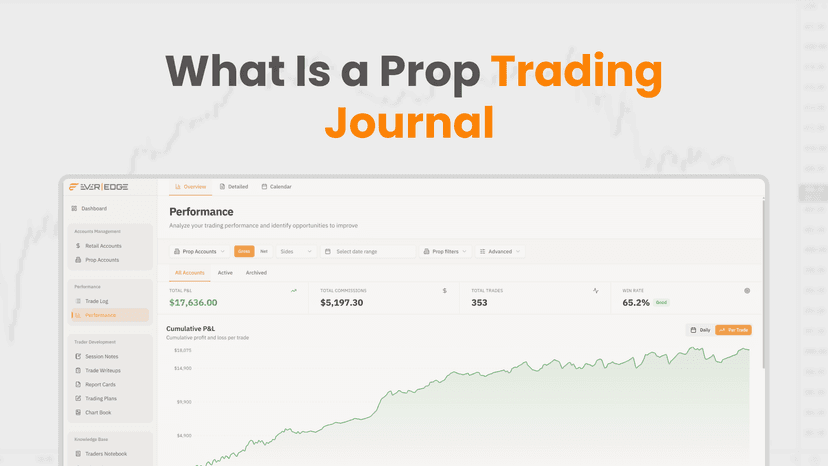
This is the one most tools miss. When you run prop accounts, you are often running a different strategy or approach on each one, or copy-trading the same setups across several. So you need two views. You need per-account performance to see how each individual account and each approach is actually doing on its own. And you need the combined view across all accounts to see how the whole operation is performing as one. A journal that only blends everything together, or only shows one account at a time, hides the answer either way.
5. Costs and ROI
Every eval fee, activation fee, and reset is a cost. Your real return is payouts received minus everything you paid to get there. A prop journal should track account cost per account and roll it up into an ROI you can actually trust.
6. Payouts, splits, and averages
Log every payout: the date, the gross amount, the profit split, your share, and the firm's share. Then see your total payouts, your average payout, and your net across all accounts. This is the number that tells you whether the whole operation is working.
7. Receipts and certificates for taxes
Keep the paper with the account. Evaluation receipts, funded account fees, activation fee receipts, payout receipts, funded certificates, and payout certificates. When your accountant asks, you are one click away instead of digging through email.
Prop firm income is real income, and prop firm fees are real business expenses. Keeping receipts attached to each account all year is the single easiest tax habit a funded trader can build.
How Everedge does it
This is the exact problem Everedge was built around, because I trade funded accounts myself and needed it to exist. Here is how the pieces map to the checklist above.
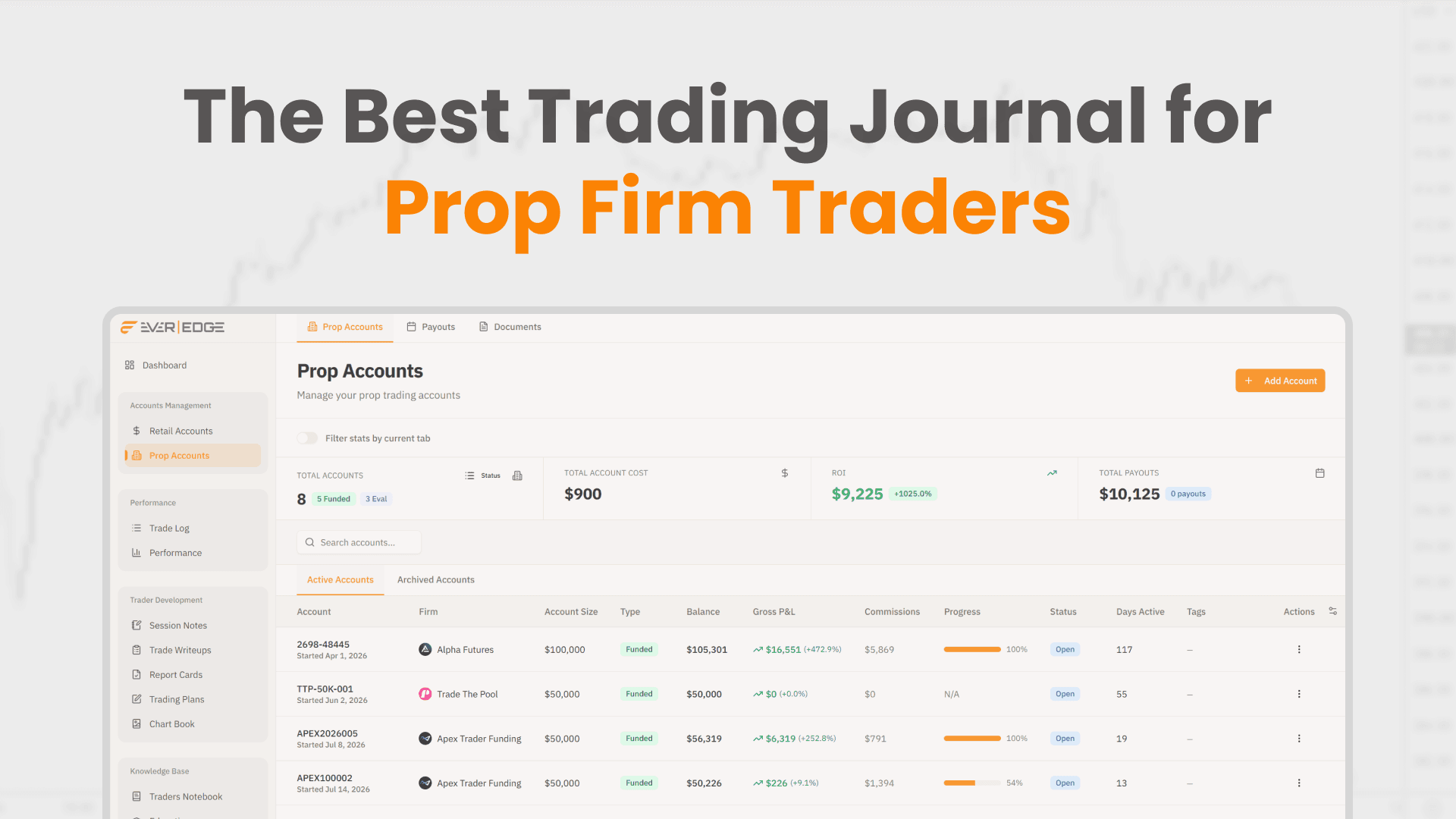
All your accounts on one screen. The Prop Accounts view lists every account you run: firm, type, size, balance, and net P&L, with archived accounts kept separately so your active list stays clean.
Add an account and pull the firm's stats automatically. When you add an account, you select the prop firm and account size, and the profit target, max daily loss, and max total loss populate for you. You can mark it evaluation or funded, attach a commission template, and add tags at the account level to group accounts however you think about them. If your firm is not on the list, you pick a custom account and enter the numbers yourself.
Track status across the whole life cycle. Set each account to open, passed, failed, scaled, or blown, and archive the ones that are done. Now the count of how many you blew at each stage is just there, not something you are trying to remember.
See performance per account, or all accounts together. Each account carries its own balance, gross and net P&L, percentage return, and commissions, so you can judge every account on its own. That flexibility matters when you run a different strategy on each account, or copy-trade the same setups across several. Right-click any account in the dashboard to open a quick-view performance dialog for just that account, without leaving the list. Or step back to the combined view and see how every account is performing together as one operation.
Payouts done properly. Log a payout with its date, gross amount, and profit split, and Everedge calculates your share and the firm's share, then rolls everything up into total payouts, average payout, and net payouts across your accounts.
Costs, ROI, and receipts. Account cost is tracked per account and feeds your ROI, and you can store the receipts and certificates that go with each account so tax season is a non-event.
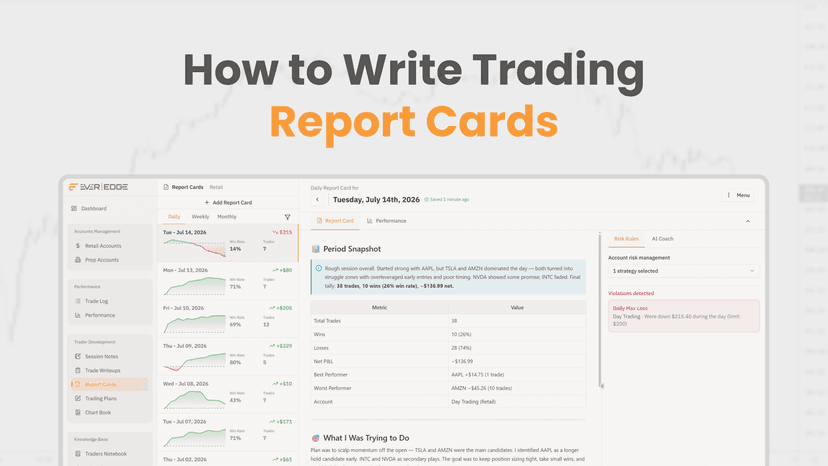
And because it is a full journal underneath, all of this sits next to your actual trading work: performance analytics, report cards, session notes, and the rest of your trader development tools, all tied to the same accounts.
The point is not more screens to fill in. It is one place where your accounts, your costs, and your payouts finally line up with your trades, so you can answer "is this working" in seconds, for one account or for all of them.
Common mistakes prop traders make with their journal
- Journaling trades but not accounts. Your trades can be green while your evaluation costs quietly eat the profit. Track the account, not just the fills.
- Blending every account into one number. If you run different strategies per account, a single blended P&L hides which approach is actually working. Watch them individually and together.
- Ignoring commissions and fees. Gross P&L flatters you. Net P&L after commissions and account costs is the number that pays your bills.
- Not logging payouts and splits. If you cannot see your average payout and your total net across accounts, you do not actually know your income.
- Losing receipts until April. Attach receipts and certificates to the account when they happen. Reconstructing them later is where funded traders lose real money to a scramble.
Ready to run this?
Set your accounts up once and let the journal do the accounting while you trade. Start your 14-day free trial and add your first prop account in a couple of minutes.
Related reading