Day trading breaks most journaling advice. The standard "write a paragraph about every trade" works fine when you take four swings a week. It falls apart when you take forty scalps before lunch. If you have ever ended a session with a hundred fills and no idea where to even start, this is the system for you. Here is how to journal day trades fast, in a way that actually builds an edge instead of just burning your evening.
Why day trades need a different approach
The whole method rests on one idea: trade small, trade often, and log everything. Early on your P&L is noise. The signal is in the record, and the record is only useful if it is structured. The problem with journaling scalps is volume and speed. You cannot stop mid-session to write notes, and you should not try. And at the end of the day, staring at a wall of executions with no structure is how good intentions turn into an empty journal.
So the goal is not to write more. It is to capture the right things with the least friction, tag them to the setup you were trading, and review by pattern instead of one fill at a time. Because the untagged trade is a wasted trade. Do this and your journal answers the only question that matters for a day trader: which of my setups actually makes money, and which ones am I forcing?
The trap is thinking a day-trading journal is just a bigger version of a swing journal. It is not. Volume changes everything. The system has to be fast enough to survive a hundred-fill day, or you will quietly stop using it.
The step-by-step system
Here is the flow, start to finish. The first step happens before the open. The rest happen after the close.
Step 1: Set your plan before the session
Before the market opens, write a short session note. Not an essay. A few lines: what the market is doing, what you are watching, which setups are in play, and your hard risk limit for the day. Call it pre-market analysis or pre-session analysis, whatever fits how you prep. This is the single highest-leverage journaling habit a day trader has, because it turns your session from reactive clicking into a plan you either followed or you did not.
Screenshot coming soon
Session Notes pre-market analysis with watchlist and daily risk limit.
Your session note becomes the yardstick you measure the day against. When you review later, the first question is simple: did I trade my plan, or did I improvise?
Step 2: Capture your trades after the close
You have two ways to get trades in. Import your fills by CSV straight from your platform, which is the fast path for a high-volume day. Or add a trade manually when you want to log one specific scalp in detail, entering its executions yourself.
Either way, you do not group anything by hand. Your executions are grouped into a trade automatically. Import a hundred fills and they resolve into the actual trades you took. Add one manually and its executions collect into a single trade for you.
Screenshot coming soon
CSV import, platform selected, trades previewed and grouped.
That auto-grouping is worth understanding, because the trade, not the fill, is the unit you journal in. A single scalp is often several executions: you scale in, add, trim, and exit. Those executions belong to one trade, and the system keeps them together so your average price, your P&L, and your review all sit at the level you actually think in.
Worth being precise here, because it matters at the next two steps: scaling in and out of one position is one trade with many executions. But if you go fully in and back out, then take the same setup again later, that is a second, separate trade. Same setup, two trades. Hold that thought.
Step 3: Tag each trade to a playbook
Now the important part. Tag each trade to the setup you were trading. Gap and go. VWAP reclaim. Overextension fade. This is your playbook, and it is a setup with criteria, not just a label on a chart. Tagging is what turns a pile of trades into data you can learn from.
To keep this fast on a high-volume day, set the playbook on your first trade and let it carry forward to the trades after it automatically. When you switch setups, say you traded gap-and-gos all morning and then faded an overextended name in the afternoon, set the new playbook on the first afternoon trade and it carries forward from there. You only touch it when the setup actually changes.
Step 4: Link your entry and exit strategies
Inside a playbook, tag the specific entry and exit you used on each trade. This is where the multiple-trades point pays off. You might trade the same gap-and-go setup five separate times in a morning, in and out completely each time, and use a different entry or exit on each one: an aggressive opening-drive entry on the first, a patient first-pullback entry on the next. Five trades, one playbook, different strategies inside it. Logging which entry and exit you actually used is how you find out which execution inside your best setup is really carrying the results.
Step 5: Review by pattern, not by fill
Now review. Because your trades are grouped and tagged, you are not slogging through a hundred fills. You are reviewing a handful of setups. Mark whether each trade met your playbook criteria, note what you saw, and grade it. The single-trade review is for the ones worth a closer look. The point is to review the decision, not just the outcome, because a good trade can lose and a bad trade can win, and reviewing a loser honestly is the habit that pays.
Step 6: Write up the setup, then close the loop
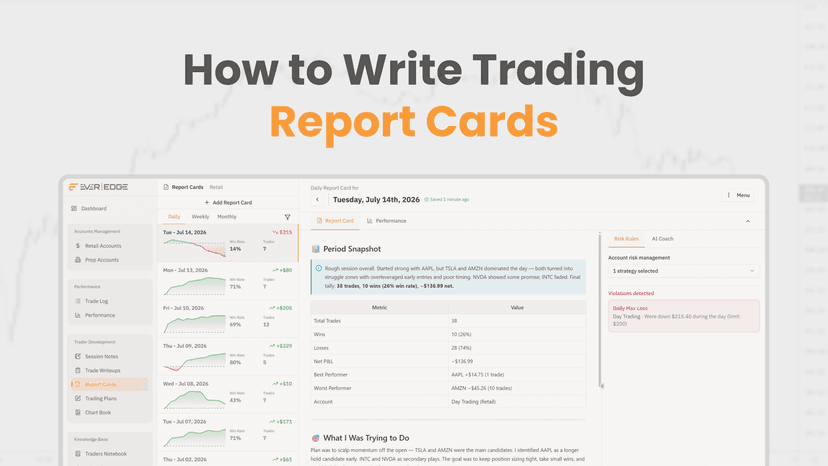
For the setups worth learning from, write a trade write-up. A write-up collects the trades that share one playbook on one ticker for one day. So if you traded that gap-and-go five separate times on the same name, all five trades go into one write-up under that playbook, and it becomes a clean example of what that setup looks like when it works, or when you forced it. Different setup on the same name gets its own write-up. Then finish with a daily report card that scores the whole session against the plan you wrote in Step 1, because one trade is noise but a day, and then a week, is a pattern.
Notice the shape of this: plan before, capture and tag after, review by setup, score the day. The writing is minimal and the grouping is automatic. The structure does the heavy lifting. That is what makes it survivable at day-trading volume.
A session, start to finish
Here is the flow on a real example. Say TSLA gaps up on news and you trade the gap-and-go.
On your first trade you scale in twice on the opening drive, trim once into the first push, then exit the rest at your target. That is five executions, and they resolve into one trade automatically, tagged to your Gap and Go playbook with your opening-drive entry attached. You mark that it met your criteria (strong gap, high relative volume, clean drive) and grade it an A.
An hour later TSLA sets up again and you take the same gap-and-go a second time, this time entering on a pullback rather than the drive. That is a separate trade, same playbook, different entry strategy. When you build your write-up for the day, both trades land in one Gap and Go write-up on TSLA, so you can see how that setup performed across every time you took it.
Screenshot coming soon
The Gap and Go write-up on TSLA collecting multiple trades, playbook tagged, criteria marked.
Later in the day TSLA runs out of steam and you fade the overextension. Different setup, so those trades get their own playbook (Overextension Fade), their own strategies, and their own write-up. By the end of the week you can see your gap-and-gos are printing and your fades are not, which tells you exactly where to lean in and what to cut.
Common mistakes day traders make journaling
- Leaving trades untagged. An untagged trade is a wasted trade. If it is not tied to a setup, it cannot teach you anything, and your per-playbook stats never take shape.
- Skipping the pre-session note. Without a plan written down, you have nothing to measure the session against, and "did I follow my plan" becomes unanswerable.
- Mixing setups in one write-up. A write-up is one playbook on one ticker for one day. Blend setups together and you hide which one actually works.
- Trying to journal during the session. You will either trade worse or journal worse. Capture after the close.
- Judging a single day by P&L. One trade is noise and one day is barely more. The pattern lives across the week, in your win rate and payoff together, not in today's number.
Start journaling your day trades
Set your plan, trade your session, and let the journal turn your fills into an edge instead of a pile of receipts. Start your 14-day free trial and log your first session in minutes.
Related reading